
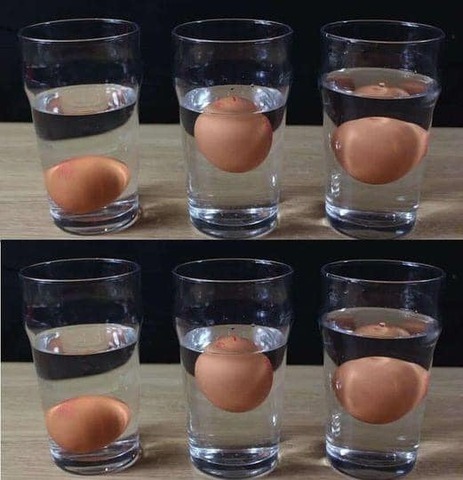
Fill a bowl with cold water.
Gently lower the egg into the water.
Watch what happens:
✅ Sinks and settles to the bottom → Fresh (1-6 days)
✅ One end lifts → A few weeks, still good
❌ Floats to the surface → Old or spoiled: throw it away
📌 Why it works: Older eggs have larger air chambers, so they float!
🚫 Don’t eat eggs that float, even if they smell good.
2. The Shake Test (Quick and Silent)
Hold the egg to your ear
Shake it gently
What you’ll hear:
✅ No sound → Fresh
❌ Sloshing sound → Old: moisture has separated, the air chamber is large
📌 Not 100% reliable, but useful for quick checks.
3. The Breakage Test (Visual Check)
Crack the egg on a plate
Examine the yolk and white:
✅ The yolk is round and tall, the white is thick and lumpy → Fresh
❌ The yolk is flat, the white is watery and spreads → No longer fresh
❌ The white is pink, green, or cloudy → Spoiled: Throw it away immediately
📌 Never eat eggs with abnormal colors or a bad smell.
4. The Smell Test (Final Safety Check)
Crack the egg and smell it
Fresh egg → Neutral or slightly eggy odor
❌ Rotten egg → Strong sulfurous odor (rotten egg): Throw it away!
📌 The odor comes from hydrogen sulfide, a sign of bacterial decomposition.
🔥 Cooking won’t necessarily mean a rotten egg is safe.
5. The Spin Test (for hard-boiled eggs)
Place a hard-boiled egg on a flat surface
Spin it like a top
What happens:
✅ It spins smoothly and quickly → Egg is just hard-boiled
❌ It wobbles or spins slowly → Egg is old or gone bad
📌 It works because fresh eggs have firmer, more centered yolks.
✅ What to do with slightly old (but still good) eggs
Not all old eggs are bad!
Use slightly older eggs for:
🍳 Hard-boiled eggs: They peel more easily than fresh ones
🧁 Baked eggs: where texture is less important
🍜 Scrambled eggs or omelettes: cook them thoroughly
✅ Avoid using eggs of questionable freshness in dishes like poached or sunny-side-up eggs, where freshness is crucial.
❌ When to throw away an egg
Throw away eggs if:
They float in water
They have a bad odor
They have cracked or slimy shells
They have pink, green, or iridescent discolorations
They are more than 3-5 weeks past their expiration date
🗓️ Eggs can be kept in the refrigerator for 3-5 weeks from the day they were laid.
🥣 Bonus: How to Store Eggs for Maximum Freshness
Store eggs in their original packaging
Protects against odors and moisture loss
Store them in the main compartment of the refrigerator
Not in the door: the temperature varies
Hold them with the point facing down
Keeps the yolk centered and the air chamber at the top
Avoid washing them until ready to use
It removes the natural protective coating (bloom)
🐔 Farm-fresh eggs? Store them at room temperature only if unwashed and consumed within 1-2 weeks.
Final Thoughts
You don’t need a doctorate to know if an egg is safe: all you need is a bowl of water, a quiet kitchen, and these 5 simple tests.
By checking for freshness before cooking, you can:
Avoid kitchen disasters
Reduce food waste
Cook with safety
So, next time you pick up eggs…
take 10 seconds to test.
Because the best frittata doesn’t start with a recipe,
but with a fresh, high-quality egg.
And that’s something worth opening.
To see the complete cooking instructions, go to the next page or click the Open button (>), and don’t forget to SHARE them with your friends on Facebook.
