
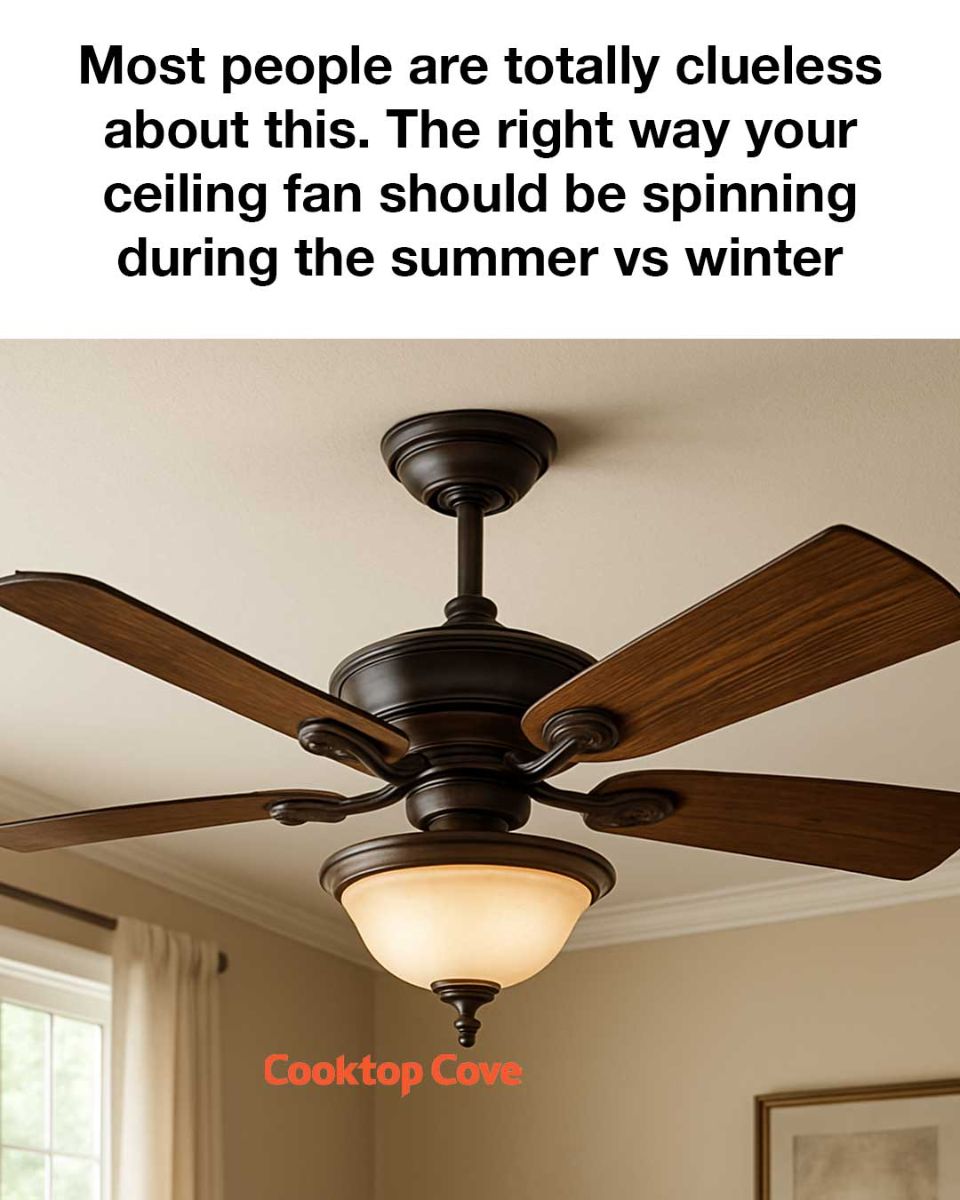
Most people are totally clueless about this. The right way your ceiling fan should be spinning during the summer vs winter
1. Understanding Ceiling Fan Direction
Ceiling fans are designed to rotate in two directions: clockwise and counterclockwise. The direction is determined by the angle of the blades and the motor’s rotation. Most ceiling fans come with a switch that allows you to change the direction of the blades, which is crucial for adjusting to seasonal needs.
In general, the counterclockwise direction is used during the summer months, while the clockwise direction is preferred in the winter. This simple adjustment can make a significant difference in how comfortable a room feels and how much energy is consumed.
2. The Science Behind Fan Rotation
The direction of a ceiling fan’s rotation affects the airflow pattern in a room. When a fan spins counterclockwise, it pushes air downwards, creating a wind-chill effect that makes the room feel cooler. This effect can make a room feel up to 4 degrees Fahrenheit cooler, allowing you to raise the thermostat setting and save on air conditioning costs.
Conversely, when a fan spins clockwise, it pulls air upwards, which helps to distribute warm air that naturally rises to the ceiling. This is particularly useful in winter, as it helps to circulate warm air throughout the room without creating a draft.
3. How Ceiling Fans Affect Room Temperature
Ceiling fans do not actually change the temperature of a room; instead, they alter the perceived temperature by affecting air circulation. In summer, the wind-chill effect created by a fan can make a room feel cooler, allowing you to rely less on air conditioning. In winter, the redistribution of warm air can make a room feel warmer, reducing the need for heating.
By using ceiling fans strategically, you can maintain a comfortable environment while reducing reliance on heating and cooling systems, leading to energy savings.
4. Summer Mode: Counterclockwise Rotation
During the summer months, ceiling fans should spin in a counterclockwise direction. This setting pushes air downwards, creating a breeze that enhances the evaporation of sweat on the skin, making you feel cooler. This effect can allow you to set your thermostat 4-6 degrees higher without sacrificing comfort, which can result in energy savings of up to 30% on cooling costs.
To check if your fan is in summer mode, stand directly under it and observe the blades. If you feel a cool breeze and the blades are moving from left to right, your fan is set correctly.
5. Winter Mode: Clockwise Rotation
In winter, ceiling fans should rotate clockwise at a low speed. This setting pulls cool air upwards and pushes warm air that has risen to the ceiling back down along the walls, helping to maintain a consistent temperature throughout the room. This can reduce the need for additional heating and lower energy bills.
To confirm your fan is in winter mode, stand under it and observe the blades. If you do not feel a breeze and the blades are moving from right to left, your fan is set correctly for winter.
6. Energy Efficiency and Cost Savings
Using ceiling fans correctly can lead to substantial energy savings. By adjusting the thermostat by just a few degrees and using fans to maintain comfort, households can save up to 15% on heating and cooling costs annually. This is because fans use significantly less energy compared to HVAC systems.
Moreover, ceiling fans can extend the life of your HVAC system by reducing its workload, leading to fewer repairs and replacements over time.
7. Common Misconceptions About Fan Direction
One common misconception is that ceiling fans cool the air. In reality, fans only move air around, which can make a room feel cooler or warmer depending on the direction of rotation. Another misconception is that fans should be turned off when leaving a room. While this is true for energy savings, if the room will be reoccupied shortly, leaving the fan on can maintain comfort levels.
Additionally, some people believe that fan direction does not matter, but as we’ve discussed, the right direction can enhance comfort and efficiency.
