
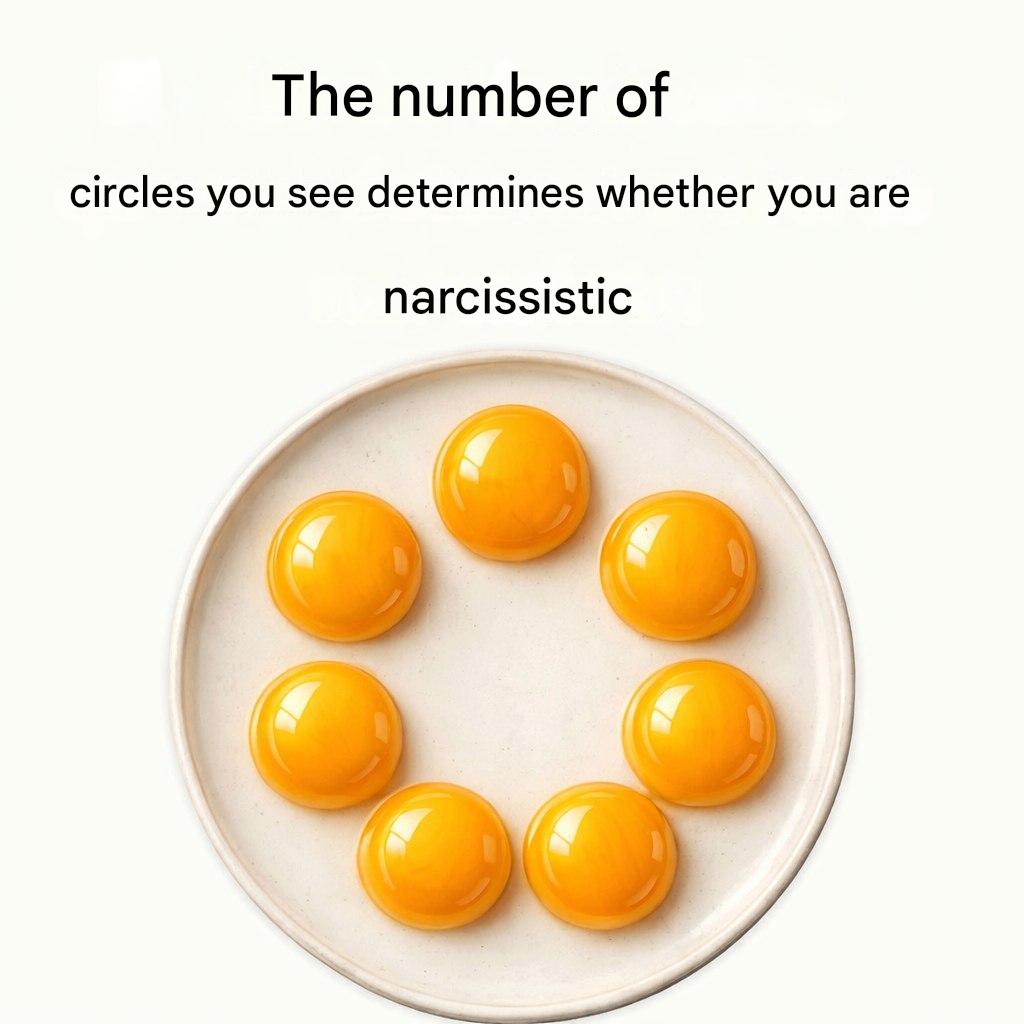
Visual challenges circulating online promise to reveal personality traits simply by looking at an image. One of the most popular claims is that the number of circles visible in an image determines whether someone is a narcissist. This idea quickly spread on social media, although, as we will see, its value in assessing psychological traits is more anecdotal than scientific.
What does this visual test propose?
The challenge involves counting the circles in an image containing obvious elements (for example, seven distinct circular shapes) and others that some people perceive as circular, depending on how they perceive the image. Based on the answers:
If you see 7 circles: You count only the most obvious elements. This is interpreted as a practical, concrete way of thinking.
If you see 8 circles: This also applies to the circle that forms the edge of the image (like the one on the plate). This is related to perception that takes into account context and surroundings.
If you see 9 circles: You recognize invisible or hidden spaces, indicating attention to subtle details.
If you see 10 or more: You count reflections, shadows, or subtle edges. This is interpreted as an analytical and detail-oriented mind that trusts its own interpretation of reality.
If you see fewer than 7: This may be due to distraction or a momentary loss of interest in a visual challenge.
These interpretations are presented in an informal and humorous tone, more as a curiosity than a formal diagnosis.
Can a simple drawing be an indicator of whether you are a narcissist?
Despite the catchy title, there is no scientific evidence linking the perception of circles in an optical illusion to narcissism or any other clinical personality trait. These types of puzzles are similar to viral games: they stimulate curiosity and are quickly shared without any real psychological basis.
Narcissism, psychologically speaking, is a complex construct encompassing deeply rooted tendencies toward an exaggerated sense of self-importance, a constant need for admiration, and, in some cases, difficulty empathizing with others. The most recognizable form of this pattern is narcissistic personality disorder, which must be diagnosed by mental health professionals using established criteria, interviews, and structured tests.
