
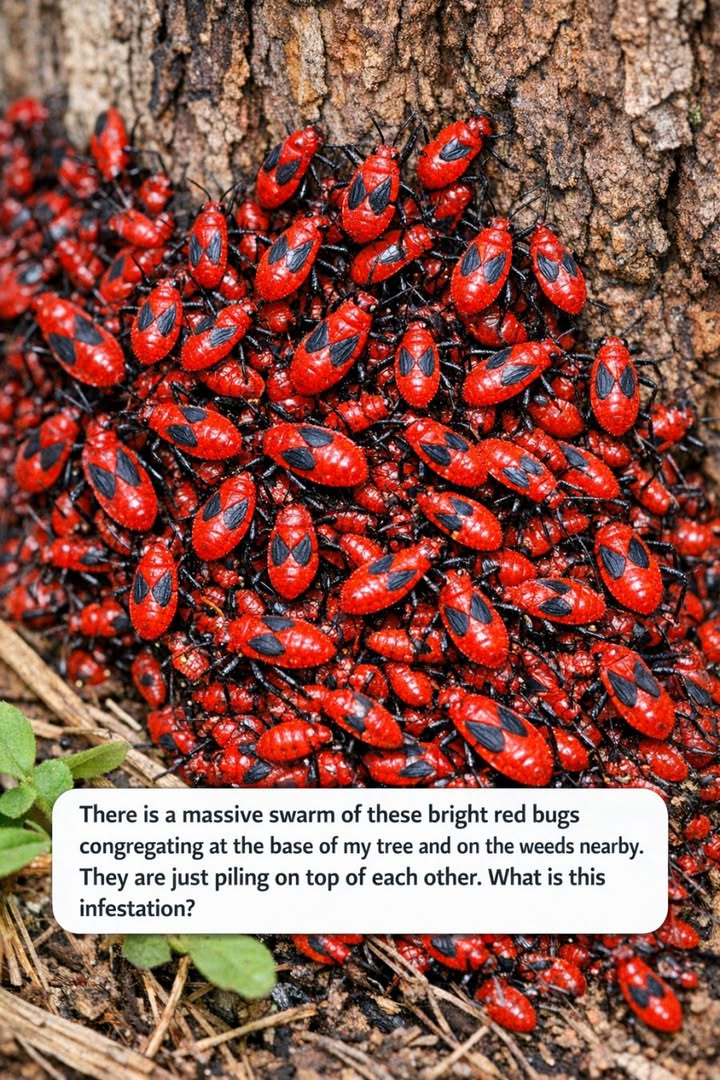
There is a massive swarm of these bright red bugs congregating at the base of my tree and on the weeds nearby. They are just piling on top of each other. What is this infestation?
Additionally, some insects exhibit gregarious behavior, meaning they tend to congregate in large groups as part of their life cycle. This behavior can be triggered by environmental factors such as temperature, humidity, and the availability of food sources. In the case of these red bugs, they are likely gathered around your tree due to the presence of specific trees that provide an ideal habitat.
2. Meet the Culprit: Boxelder Bug Nymphs Explained
The bright red bugs you’re observing are likely boxelder bug nymphs. Boxelder bugs (Boisea trivittata) are common insects found throughout North America. They are named after the boxelder tree, which is one of their preferred hosts. The nymphs, or immature stages, of boxelder bugs are bright red with black markings and measure around 1/16 to 1/4 inch in length.
These nymphs emerge during the late spring to summer months and grow into adults by fall. They feed primarily on the seeds of boxelder trees, but can also be found on maple trees and other related species. While they primarily feed on seeds, they can also pierce plant tissues, although they rarely cause significant damage.
3. How To Positively Identify Boxelder Bug Nymphs
Identifying boxelder bug nymphs is relatively straightforward due to their distinct coloration and markings. Nymphs are bright red with black wing pads and markings on their abdomen. As they mature, the red color becomes less dominant, and they develop black wings with red veins.
Another identifying feature is their behavior. Boxelder bug nymphs are often found in large groups, particularly on south-facing tree trunks, sunny sides of buildings, and near foundations. Observing these characteristics can help you accurately identify them and distinguish them from other similar-looking insects.
4. Why They’re Piling On Top of Each Other in Huge Clumps
Boxelder bug nymphs pile on top of each other for several reasons. Primarily, they seek warmth and protection, especially as temperatures begin to drop in the fall. By clustering together, they can conserve heat and reduce exposure to predators.
This behavior is also driven by their search for food and overwintering sites. As boxelder trees and other favored plants become less abundant, the bugs congregate around remaining sources and prepare for hibernation. This clumping is a natural part of their lifecycle and generally does not indicate any aggressive or harmful behavior.
